There is no more significant regional food in the US than the sandwich. The choice of what to put between two slices of bread (or a hinged roll) can vary to such a degree that towns within an hour of each other may be unaware of their respective beloved icons. These factional traditions don’t stop at what makes up a sandwich and can extend to what to call the very same recipe, most notably with a sub (or hoagie, or grinder, or hero, or wedge, or Italian…). Sandwiches can have different rules, different preparations, different terminology and ways of ordering. They can be as delicate and simple as a tomato sandwich or as overstuffed and messy as a Thanksgiving gobbler. They may have immigrated from Vietnam or Cuba just as easily as they were created by immigrant communities already arrived. They are characteristically American in this way, but also in their working-class convenience and humble, honest environs, which can be perverted in the equally American quest to gild everything and create financial and social barriers to access. They are specific geographically, ethnically, socially, yet they are united by their structure and philosophy. They contain multitudes in the literal and figurative sense of “contain” and “multitude.”
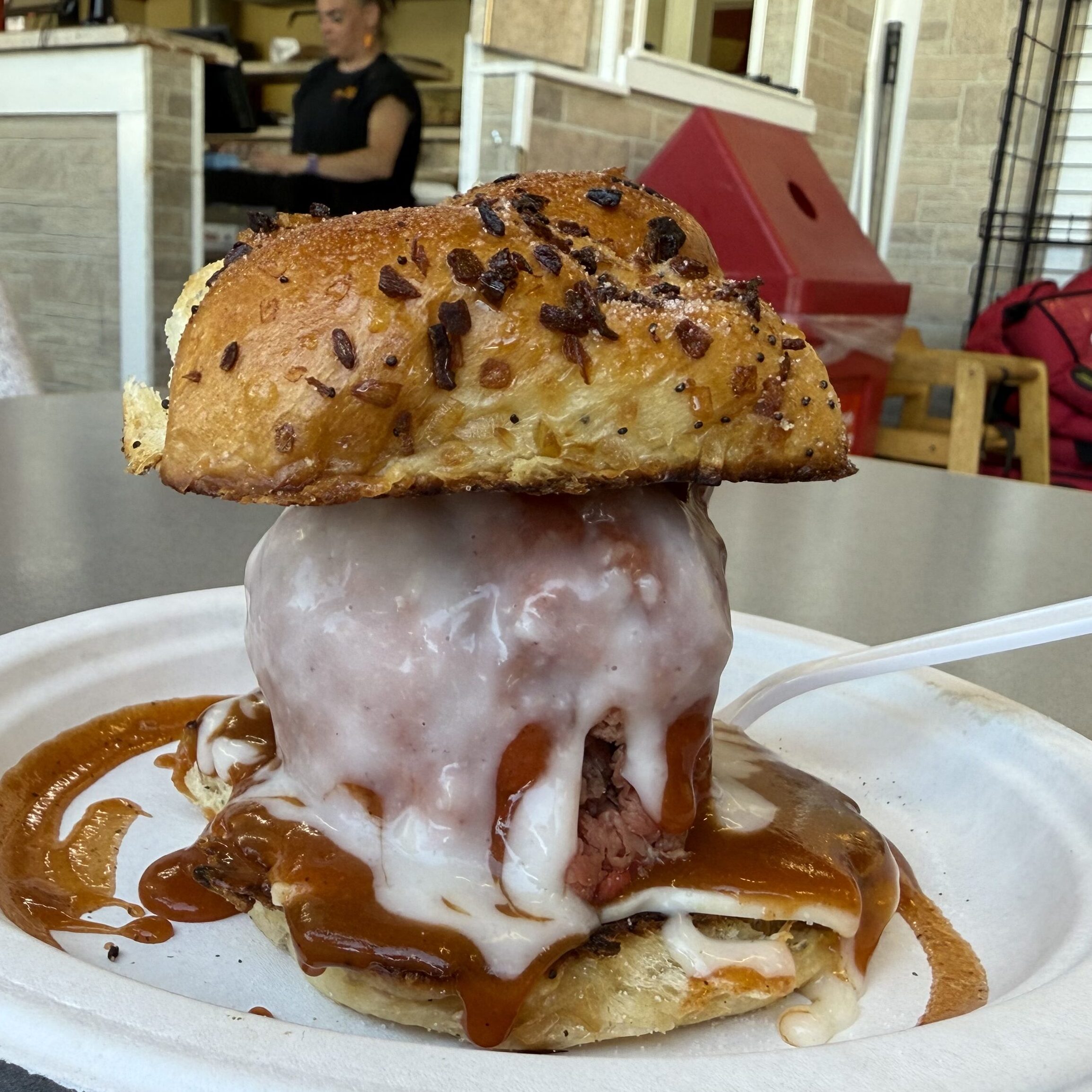
A junior on an onion roll at C&S Pizza in Pepperell
Yet there isn’t much to a North Shore roast beef sandwich. At most of its notable homes, its beef comes from a wholesale provider, its bun from an industrial bakery, its sauce from the mid-Atlantic region. In terms of ingredients it does not differ significantly from what you can get at a supermarket deli, wrapped in butcher paper and held together by scotch tape. Many of the best beef shops have other items in their name, so they declare things like Roast Beef and Pizza or Roast Beef and Seafood. Their menus have subs and sides and salads and somewhere in the corner are a handful of options: junior and regular and super. These are the beefs and they aren’t distinguished from the rest of the menu any more than their shop is distinguished from another down the street that might serve a markedly different product. Like a regular lane in Boston that becomes a left-turn-only without notification, it’s through experience that one must understand what separates one beef shop from another.
The basic building blocks that define a North Shore roast beef sandwich are simple. The beef itself is round, usually bottom round, cooked medium rare and sliced paper thin. It’s served on a hamburger bun, though depending on the shop and size of the order this bun can vary; generally, you can expect a plain hamburger bun for a junior, a sesame seed bun for a regular, and an onion roll for a super. Along with the beef, a typical order comes with bbq sauce, a slice of American cheese, and mayo. These ingredients make up the “3-way,” the most famous and traditional order. Other acceptable toppings include horseradish (sauce or, if you’re lucky, fresh grated) and a couple of onion rings (adding these is usually what a 4-way refers to these days). At old-school beef joints this is wrapped in paper and stuffed in a bag with too many (yet ultimately not enough) napkins, but top-tier shops have begun serving them in-house on a disposable paper plate, often with a fork stuck in the side.
Anyone who has attempted to make the perfect version of a simple dish can immediately see the complexity of executing a perfect North Shore beef surveying these ingredients. The beef must be seasoned, cooked, and sliced precisely so that it holds together without being chewy, melts in your mouth without being mushy, seasoned but not overpowering. The bun should be griddled to within a second of being burned, crispy with bits of buttered texture to break up the yielding texture of the mayo and beef. There is only one choice for bbq sauce, and it’s James River, a sauce that was created over 500 miles away in Virginia. But the sauce should be generously applied (unless you are a coward and get it on the side) and as warm as the beef. The mayo is most often Cain’s, and I have to admit I usually replace it with horseradish sauce, which gives the sandwich a bit of a kick. The cheese must be on the bottom to keep the bottom bun crispy and the beef in place. If you’re lucky, there will be a light dusting of crunchy salt and a bit of pepper over the top of the sandwich.
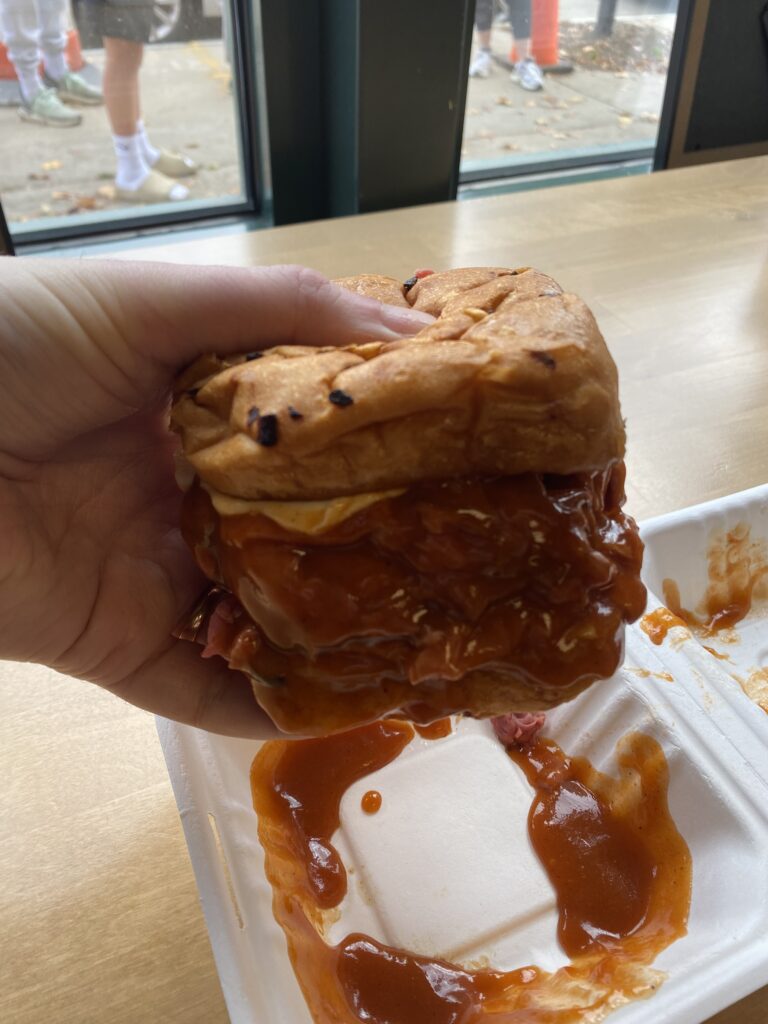
A monster 3-way at The Modern Butcher
When all of this is executed well, the sandwich becomes something other than what it might seem. There is sweetness and tartness from the sauce, a delicate crunch from the grilled, warm bun, and powerful beef flavor without any of the chewiness or resistance that can come from poorly sliced or cooked roast beef. There is a unified wholeness of temperature, consistency, and flavor that is hard to forget once you’ve got it on your mind. At a modern shop, sauce will be everywhere and stick to your hands and face and anything you haven’t securely locked down. There are other great regional roast beef sandwiches – the french dip from Los Angeles, the beef on weck from Buffalo, the cheesesteak from Philadelphia. None of these are as delicate and yet improper as the North Shore beef. Its bold overflowing presentation and powerful flavor mimic the culture that birthed it; to know one is to know the other. ■
The History of the Beef
The North Shore roast beef was invented at Kelly’s in Revere in 1951. There’s always a happy accident in the potentially invented origin story, and this one is about leftover roasts from a wedding the owners of Kelly’s had been working at next door. The success of this makeshift sandwich converted the shop from a hot dog stand to a roast beef house overnight. Kelly’s has been hand-carving their roast beef ever since, branching out into a mini-empire across the Boston area in the ensuing decades. A branch of Kelly’s was the first place I had a North Shore roast beef, and it was an underwhelming experience; Kelly’s is essentially a slightly better Arby’s at this point, though the original Revere location is not a terrible stop on a beef mecca.
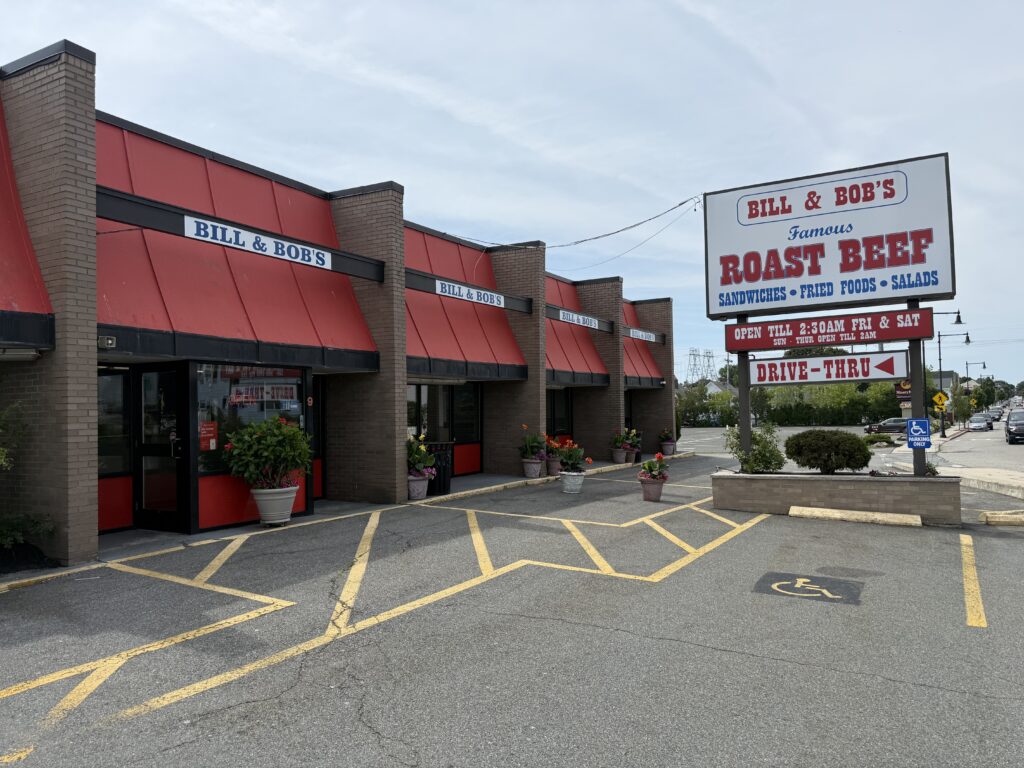
The original Bill and Bob’s in Salem
After these humble beginnings, the most important development in beef came in 1968, when Nondas Lagonakis purchased Bill and Bob’s in Salem from the original owner. This marked two major milestones. The first was the beginning of Greek ownership in beef shops. This is around the same time that Greek pizza was flooding Massachusetts, with immigrants who were trained in the New London, CT, area moving north to open their own shops (a story for another time). Lagonakis’s hires would follow a similar path, with subsequent Greek founders of classic shops like Land ‘N Sea, Zeno’s, and Nick’s having trained at Bill and Bob’s.
The second and more crucial contribution Lagonakis made to the beef was the development of the bbq sauce that adorns it and is the only non-negotiable branded ingredient in the sandwich. James River bbq sauce was originally created in Virginia for pork sandwiches, but had been adopted as the go-to topping for beefs. Family lore has it that Lagonakis went to Virginia and refined the sauce to suit his needs, working with the company to thicken the sauce so that it maintained structure when warmed and strengthen its vinegar profile until it was to his liking. This sauce, which is actually now called Smithfield BBQ and is purchased in giant gallon plastic jugs, is the same one used today.
In recent years there have been variations on the sandwich that have taken hold. Adding a couple of onion rings to the top is a regular move now and is generally accepted as the meaning of the 4-way order. More radical is the Greek beef, a tribute to the sandwiches many Greek immigrant pioneers and current creators. This is a roast beef sandwich with lettuce tomato and onion as the base, topped with Greek salad dressing instead of bbq sauce and sometimes a sprinkling of feta. This is the only time you’ll see a beef expert with lettuce on their sandwich.
This humble sandwich is often given a supporting role at the majority of shops across the North Shore, and until recently the sandwich was largely unknown throughout the country. It lacks a compelling name like po’ boy or cheesesteak; a roast beef sandwich hardly seems like an anomaly next to these coined idiosyncrasies. There is also an admirable camaraderie among beef house titans; there is no Pat’s and Geno’s or Pepe’s and Sally’s rivalry that spans decades and builds sacred lore.
Ferg’s beef logo for his Facebook group
The profile of the North Shore Roast Beef was upped considerably when Andy Ferg started a Facebook group celebrating the sandwich. This group has grown to tens of thousands of members, and Ferg has built it into a social brand, selling merch, hosting a podcast, and generally presiding over the cultural history and landscape of the sandwich. Ferg’s group is not for everyone – it’s intentionally hyper-rude, vulgar, and generally aggressive, though all with a self-aware wink that’s hard to miss. His Beef Madness tournament pits the best shops against each other and generates thousands of votes and plenty of business for the top winners. While there is an attitude among some fans that forces conformity onto beef shops that continue to deliver an old-school product rather than the giant stacks and hyper elevated specimens that generate the most hype and the best ratings on the page, Ferg himself is a major champion of the originals and their dedication to tradition. Like Geno’s and Angelo’s in Philly, there is a place for the fast food and high cuisine versions on the North Shore, and there’s something to celebrate in both. ■
Where to North Shore Beef
There are currently a handful of shops that are consistently cited as essential North Shore roast beef houses.
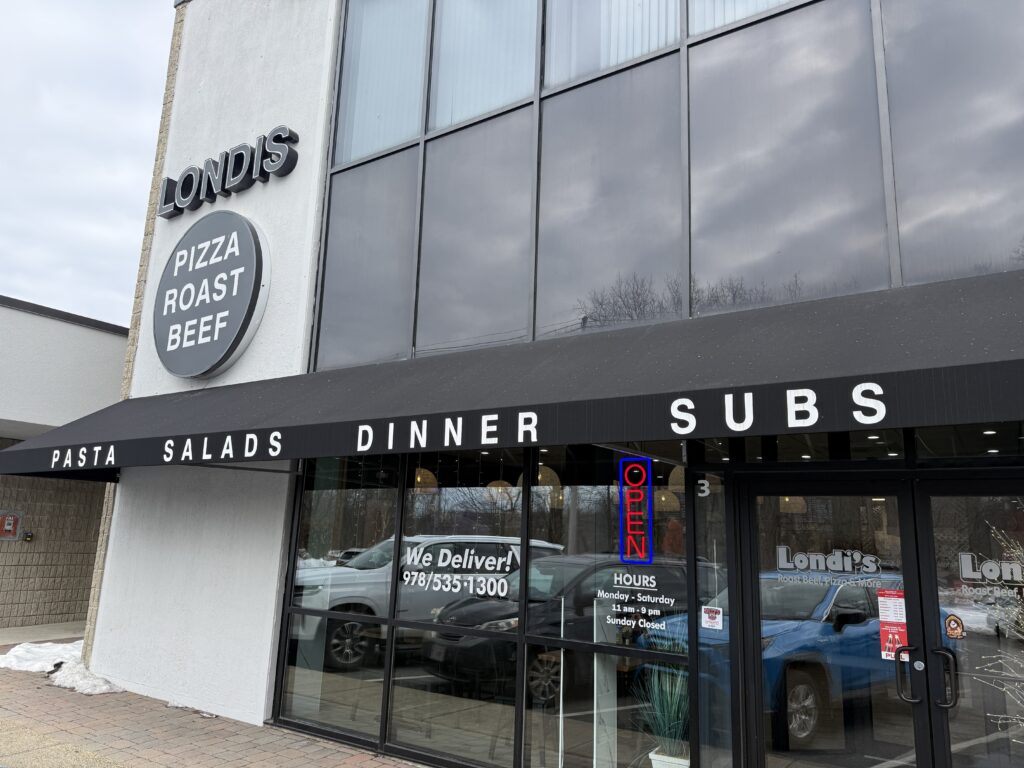
The real Londi’s in Peabody
The most famous is probably Londi’s in Peabody. Ted Londi built a reputation out of Peabody that helped him create a franchise model throughout the region. Unfortunately, not all of those shops were able or willing to maintain the same level of quality, and he quickly returned to his Peabody location to restore order at the flagship. The North Andover location also gets good reviews but if you aren’t in Peabody you aren’t having a true Londi’s beef.
Other top tier shops serving the modern incarnation of the sandwich include Bella’s in North Andover, Pete’s in Woburn, Zeno’s in Ipswich, Tessi’s in Tewksbury, and Nick’s in Burlington. Of these shops, I strongly recommend Pete’s, which features a sandwich I think about on a semi-weekly basis. The son of the owner of Nick’s recently opened a shop in Woburn called Mad Matt’s, which in my opinion is even better than Nick’s, and has the potential to be one of the greats.
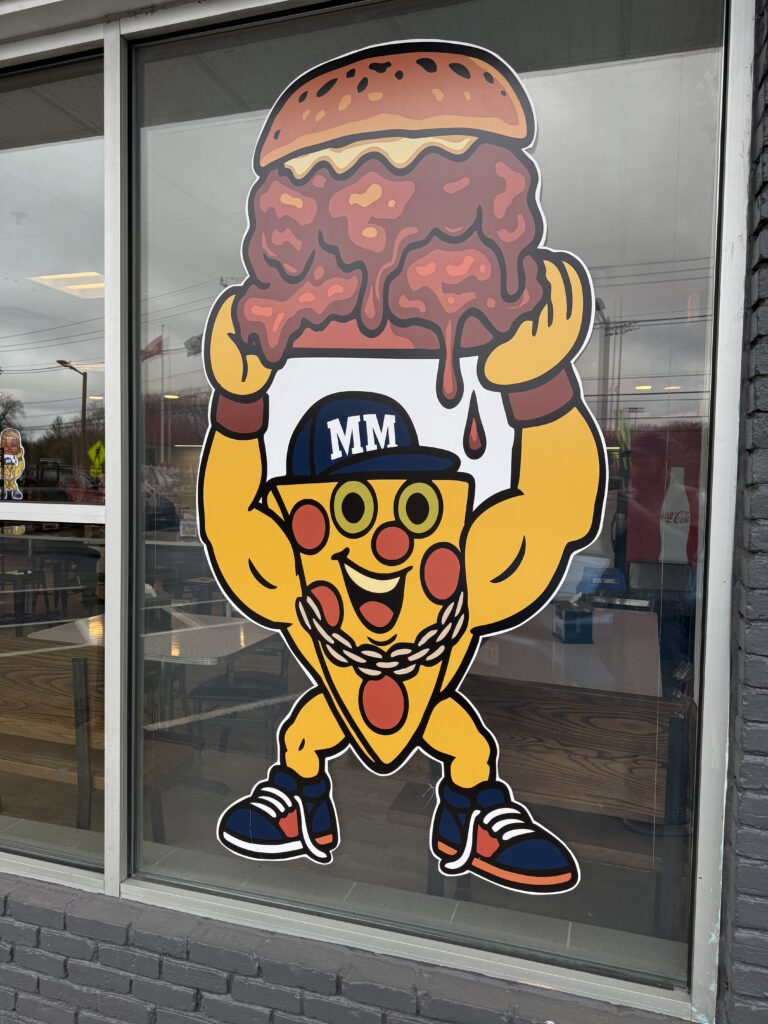
The beef-slinging pizza at Mad Matt’s
Two additional unusual entries in the top shelf beef rankings must be mentioned. The fantastic butcher shop The Modern Butcher, originally in Newburyport but now in Danvers, sells a roast beef sandwich every Saturday starting at 11. I specify the opening time because if the weather is nice and you want a sandwich you should probably get there at 10:30 and be prepared to wait. Because The Modern Butcher is a whole-animal butcher shop, they only have a certain amount of beef to make the roasts, so once they are sold out they are finished. This is the best quality and best tasting beef you will have on a North Shore roast beef sandwich, and it’s something every connoisseur should try at least once.
The other unusual shop is C&S Pizza in Pepperell. For those who aren’t familiar with the less populated geography of Massachusetts, it must be noted that Pepperell, about twenty minutes west of Lowell, is decidedly not on the North Shore. But owner Bill Gikas has transformed his pizza shop into a road trip destination for beef aficionados. This is where I probably had the closest to a perfect beef I’ve encountered, and it’s proof that great producers can deliver this sandwich regardless of where they are in the Commonwealth.
Sometimes you want elegant beefs and sometimes you just need to stuff your face. For those times there is Nick’s in Beverly, or if you are a night owl the original Bill and Bob’s in Salem, which is open until 2:30am on the weekend. There are other locations of Bill and Bob’s that are equally good but they lack the ambiance (drunk dudes fighting). The original Kelly’s is still on Revere Beach and is a must-visit for anyone who is a fan of beefs or Massachusetts regional food history. I’ve seen pictures of Land ‘N Sea’s current beefs and I just can’t do it, so more power to you if you want to take the plunge.
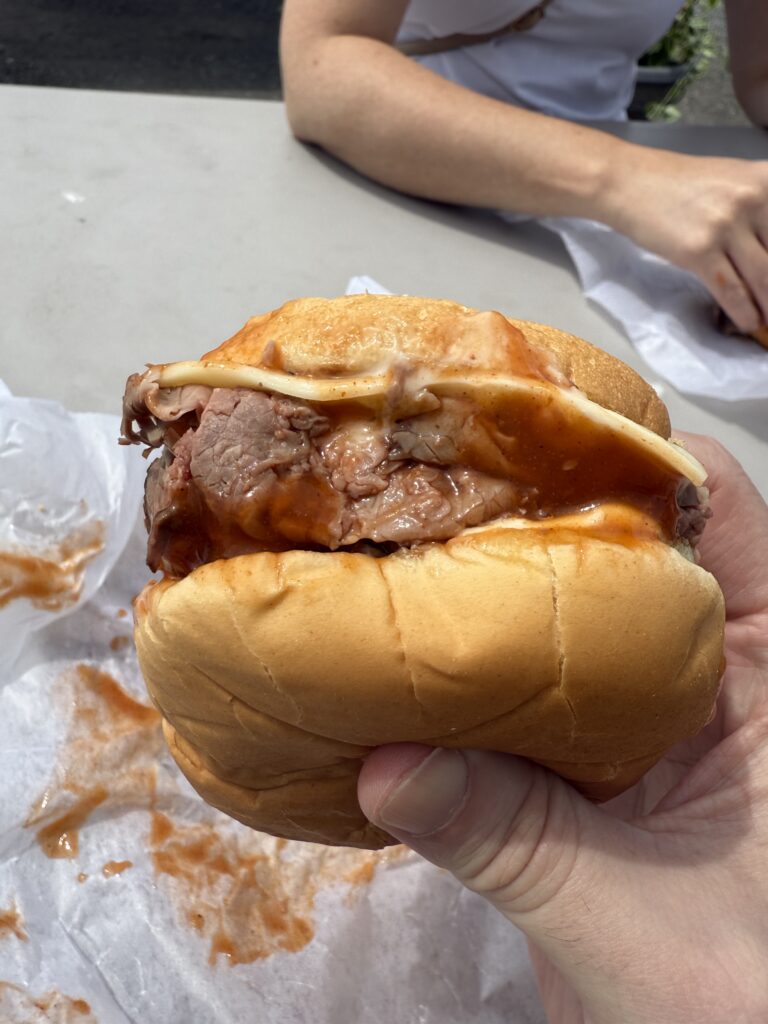
A true junior old-school beef at Bill and Bob’s
My map below has all of these shops with their location, along with some additional shops that are noteworthy and worth exploring if you’re in the area. ■
If you can only have one:
The very best beef is always going to be debatable, but for a full beef experience the place that is always going to deliver is Pete’s in Woburn. It’s tucked into a small space in between auto repair shops, features a classic array of beef and pizza menu items, and delivers a perfect sandwich consistently, just a few minutes off 95.
If you want the full picture:
You can graduate from beef novice to intermediate status by expanding to The Modern Butcher, Londi’s in Peabody, Zeno’s in Essex, and Bill and Bob’s in Salem.
Beyond the North Shore:
The two generally agreed-upon respectable beefs not in Northeastern Mass are Mark’s Pizza and Subs in Wellesley and especially Tostimo’s, which is an honorary North Shore beef despite being over the border in New Hampshire. Summit’s Place, which has two locations, is probably the best option for South Shore beefing, as their location in Holbrook gets good reviews. Boston proper lacks a notable beef, but the Cutty’s roast beef sandwich in Brookline is an excellent sandwich on its own (just don’t think of it as anything like a North Shore version).